Complete Guide to Driving in Phuket: Rules, Roads & Safety
Eighty-seven percent of Phuket road fatalities involve motorcycles — a hire car is the safest way around. Learn the local road rules, avoid heavy fines, and navigate the island's steep coastal roads.
Search & Compare Car Hire Deals
Free cancellation on most vehicles
Thai Driving Rules for Visitors
Navigating the roads of Thailand presents an engaging experience for international visitors who choose to hire a car, provided they understand the fundamental operational differences. The nation adheres strictly to a left-hand traffic system, dictating that all legally registered vehicles operate with a right-hand drive configuration. Fortunately for visiting motorists, the vast majority of local car hire fleets consist of automatic transmission vehicles. This widespread availability of automatics significantly eases the mental transition, allowing you to focus entirely on external traffic flow rather than manual gear selection. However, tourists taking to the roads on their first day routinely fall victim to standard muscle memory mistakes. The most common error involves confusing the windscreen wipers with the indicator stalks, leading to frantic wiping at busy intersections. Furthermore, drivers accustomed to right-hand traffic often unconsciously drift towards the right-hand lane or the centre line. Maintaining a conscious awareness of your road positioning during those initial hours is crucial for a safe journey.
Fulfilling the strict driving licence requirements is an absolute necessity before you sign an agreement. To operate a vehicle legally in Thailand, you must carry your original home country driving licence, your physical passport, and a valid 1949 Geneva Convention International Driving Permit (IDP). If you intend to collect your vehicle immediately after landing, our comprehensive Phuket Airport car hire service strictly requires these three documents at the handover counter. Local traffic police actively operate routine checkpoints specifically targeting foreign tourists at major bottlenecks, including the Chalong Circle, the main junction in Karon, and the notably busy base of Patong Hill. Failing to present an IDP at these checkpoints will result in an immediate 1,000 to 2,000 THB fine. More critically, driving without the correct permit instantly and completely voids your vehicle insurance policy, leaving you personally liable for all third-party damages in the event of an accident.
2023-2026 Traffic Fine Reforms and Speed Limits
| Offence | Penalty / Fine (THB) |
|---|---|
| Seatbelt violation (all passengers including rear) | 2,000 THB each |
| Missing child seat (under 6 years or under 135 cm) | 2,000 THB |
| Using a mobile phone without a hands-free system | 4,000 THB |
| Speeding or running a red traffic light | Up to 4,000 THB |
| Drink-driving (BAC over 0.05%, or 0.02% for licences under 5 years) | 5,000 to 20,000 THB and possible jail |
The Thai government has recently implemented stringent road safety campaigns, dramatically increasing the penalties for standard traffic offences as detailed above. Beyond financial penalties, motorists must remain acutely aware of local speed limits. Urban zones and heavily populated municipal areas enforce a maximum speed of 50 to 60 km/h, whereas rural routes and larger arterial highways theoretically permit travel up to 90 km/h. However, visitors quickly discover that Phuket lacks any high-speed, controlled-access expressways. Your actual journey times are dictated entirely by unpredictable local traffic, wandering stray dogs, and slow-moving commercial transport rather than the raw speed limit. For further queries regarding documentation, regulations, and safety advice, please consult our dedicated FAQ page. Before finalising transport plans for your upcoming trip, take a moment to compare cars across our network to find a fully insured vehicle that perfectly suits your requirements.
Patong Hill & Phuket's Roads
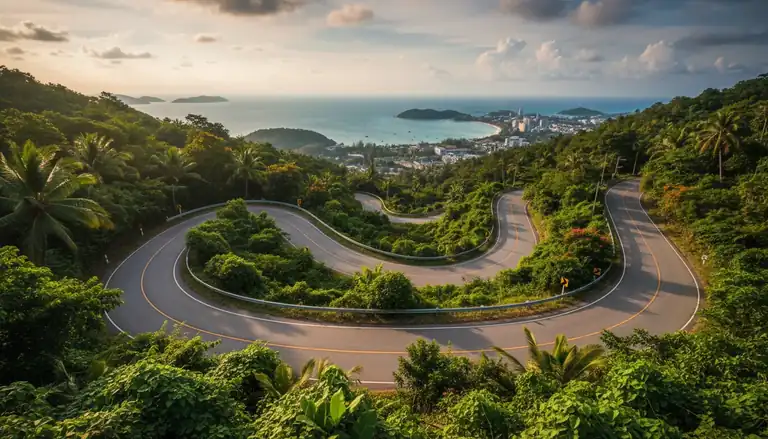
Patong Hill, officially designated as Highway 4029 forming the Kathu to Patong pass, undoubtedly stands as the most dangerous road in the province. Drivers attempting this route face punishing gradients of up to approximately 15 percent, combined with aggressively tight switchbacks that leave absolutely no margin for driver error. Brake fade is the primary killer on this specific descent because inexperienced motorists continuously ride the foot brake all the way down the mountain, boiling the brake fluid and completely losing stopping power. Instead of relying on the pedal, you must manually shift your automatic gearbox down into the L or D2 position to forcefully utilise engine braking. While a sand-filled arrester or escape ramp exists near the bottom of the descent for runaway vehicles, being forced to use it signifies a severe, potentially fatal failure in driving technique. If you prefer acquiring a local vehicle directly in the resort town itself, our trusted Patong car hire options provide thoroughly inspected vehicles with well-maintained brakes and reliable engines.
The island's broader road network presents a distinct array of daily challenges that require constant vigilance. To put the environment into perspective, official 2018 traffic data reveals that a staggering 87 percent of Phuket road deaths directly involve motorcycles, highlighting exactly why choosing to hire a car provides a vastly superior safety buffer. The primary spine of the island is Highway 402, widely known as Thepkrasattri Road, which handles the heaviest traffic volume and is notoriously dangerous due to locals executing sudden, high-speed U-turns. The Bypass Road, officially Route 4022, offers a faster north-to-south alternative but becomes highly prone to severe flash flooding during heavy downpours. Meanwhile, the dramatically winding coastal roads linking Kata, Karon, and Nai Harn in the south, alongside the steep stretches connecting Kamala to Surin in the north, feature treacherous blind bends and remain entirely unlit at night, demanding reduced speeds after sunset.
Navigating Key Local Hazards and Intersections
Understanding the unwritten rules of specific traffic blackspots will significantly lower your stress levels while exploring the local infrastructure.
- Patong's one-way beach system: The traffic flow immediately adjacent to the sand on Thaweewong Road operates exclusively southbound, while the parallel Rat-U-Thit Road directs all traffic northbound in a continuous loop.
- Roundabout etiquette: At major junctions like the Chalong Circle and the Heroines' Monument, assertive but predictable merging is required; conventional right-of-way rules are loosely applied, and hesitation often causes rear-end collisions.
- Motorcycles passing on the inside: You must comprehensively check your left mirror and perform a shoulder check before making any left turn, as local moped riders frequently undertake larger vehicles regardless of your active indicators.
- The delayed Kathu-Patong tunnel: Initially promised by the government as a flat-gradient alternative to the terrifying hill pass, this highly anticipated infrastructure project has faced numerous delays and is only targeted for completion around 2029 to 2030.
Fuel, Parking & Distances
Refuelling a hire car in Thailand operates on a highly convenient full-service model, meaning you will never actually need to leave the driver's seat or touch a petrol pump yourself. The primary nationwide operators dominating the local landscape include PTT, Shell, Caltex, PT, and Bangchak. It is worth noting for returning visitors that all former Esso stations were completely rebranded to Bangchak throughout the 2023 to 2024 corporate merger. The fuel types available are heavily regulated and clearly colour-coded at the pump. Gasohol 95, the most common choice, costs roughly 40 to 43 THB per litre, while Gasohol 91 hovers around 40 THB. The more economical E20 blend sits between 35 and 36 THB, and standard commercial diesel averages 38 to 39 THB. You must always instruct the attendant to match the specific pump nozzle to the advisory sticker permanently affixed inside your vehicle's fuel flap, as putting diesel into a standard petrol vehicle will catastrophically destroy the engine.
Navigating the strict local parking laws requires constant, unwavering attention to the specific colours painted on the concrete kerbs. A red-and-white painted kerb unequivocally indicates a strict no-parking zone at all times; violating this rule routinely results in local police applying an immobilising wheel clamp to your vehicle and issuing a 500 to 1,000 THB fine that must be paid at the station. Finding suitable parking spaces in the heavily congested Patong area is tight and often frustrating. Your most reliable strategy is utilising the massive underground facility at the Jungceylon shopping mall, which generously offers the first 30 minutes for free and subsequently charges a reasonable rate of roughly 20 THB per hour.
Regional Parking Rules and Driving Distances
When venturing out to experience the rich heritage of Phuket Old Town, be aware that street parking operates on a strict odd and even-day system depending on the calendar date. Furthermore, municipal authorities completely close Thalang Road to all vehicular traffic for the famous Sunday Walking Street market between 16:00 and 22:00. Conversely, major tourist attractions spread across the island, such as the magnificent Big Buddha, the historic Wat Chalong, and the breathtaking Promthep Cape, provide ample, well-organised free car parks for visitors. Understanding these logistical nuances and planning your daily itinerary properly ensures you can comfortably and safely undertake spectacular Phuket day trips by car without the constant fear of accumulating parking fines or facing a clamped wheel.
| Destination from Patong | Approximate Distance | Estimated Driving Time |
|---|---|---|
| Phuket Town | ~15 km | 25 to 50 minutes |
| Kata and Karon Beaches | ~10 km | 15 to 25 minutes |
| Big Buddha | ~23 km | 35 to 45 minutes |
| Promthep Cape and Nai Harn | ~16 to 21 km | 35 to 50 minutes |
| Phuket International Airport (HKT) | ~40 km | 45 to 60 minutes |
| Sarasin Bridge | ~47 km | 45 to 55 minutes |
| Khao Lak | ~90 to 100 km | 1.5 to 2 hours |
Monsoon, Songkran & Accidents
The island's tropical climate dictates that the green or monsoon season, which heavily impacts the region from May through October, frequently brings intense, unpredictable flash floods to low-lying ground. The underpasses along the Bypass Road, the congested streets of Patong, and the sprawling intersections of Chalong are particularly vulnerable to sudden inundation. You must absolutely never attempt to drive a hire car into standing water. If water is ingested into the engine bay, the resulting hydro-lock damage will instantly and permanently void your insurance policy, leaving you fully liable for a total engine replacement. Another critical period demanding heightened awareness is the Songkran water festival in mid-April. Officially dubbed the 'Seven Dangerous Days' by the Thai government, this nationwide holiday brings rigorous drink-driving crackdowns and enthusiastic locals throwing vast quantities of water at moving vehicles, requiring extreme caution, low speeds, and permanently closed windows.
Warning: Cheap street-side operators sometimes supply a vehicle covered only by a private, rather than commercial, insurance policy. In the event of a serious crash, the insurance underwriter can legally void the entire coverage upon discovering the car was being hired out for profit, leaving the tourist fully financially liable. Always insist on seeing a proper commercial first-class policy document and conduct a meticulous 360-degree video inspection at handover.
Should you experience the misfortune of a collision, the required accident protocol in Thailand differs vastly from established Western norms. You must not move the vehicles under any circumstances until either the local traffic police or your official insurance surveyor physically arrives at the scene; prematurely relocating the cars to ease traffic congestion can legally transfer the full blame to you. Immediately call your car hire firm's 24-hour emergency hotline, followed by dialling 1155 to connect with the Tourist Police, who have dedicated English-speaking officers on duty. While waiting for the authorities, step safely away from moving traffic and photograph the entire scene extensively from multiple wide and close-up angles. Crucially, never allow anyone to pressure you into signing a Thai-language legal document or liability admission that you cannot comprehensively read and understand.
Critical Emergency Contacts
- 191 – Royal Thai Police (For general law enforcement emergencies and immediate physical danger)
- 1155 – Tourist Police (Dedicated English-speaking assistance for foreign visitors facing legal or safety issues)
- 1669 – National Ambulance and Medical Emergency Service (For severe injuries requiring immediate hospitalisation)
- 1193 – Highway Police (For serious collisions or breakdowns occurring specifically on major arterial routes)
Frequently Asked Questions
Do I need an IDP to drive in Phuket?
Is Patong Hill dangerous and how do I drive it safely?
What should I do after a car accident in Phuket?
Can I drive through flooded streets in the monsoon?
Ready to compare car hire deals in Phuket?
Check live prices and availability from local and international suppliers.
Compare car hire deals